Saturday, September 5, 2009

Saturday Snippet: He Died With a Felafel in His Hand

In the early 1990s John Birmingham lived with 89 people in a dozen different shared houses in Melbourne and Brisbane and kept notes on all of them. He Died With a Felafel in His Hand (Yellow Press, 1994) reveals snippets about the flotslam of housemates that drifted through his various abodes and details some hilarious anecdotes of the goings-on and the weird twilight world of shared multi-unit, rental accommodation. It's one of my favourite books with a guaranteed smirk or belly laugh on every page. What the book reveals is that everybody has strange little quirks, and some have very large ones, that drives other people nuts; and that friendships grow, twist and mutate, alliances form and fracture, and people bond and then fall out spectacularly. It starts thus,

He died with a felafel in his hand. We found him on a bean bag with his chin sitting on the top button of a favourite flannelette shirt. He'd worn the shirt when we'd interviewed him for the empty room a week or so before. We were having one of those bad runs, where you seem to interview about thirty people every day and they are all total zipper heads. We really took this guy in desperation. He wasn't A-list, didn't have a microwave or anything like that, and now both he and his felafel were cold. Our first dead housemate. At least we got some bond off him.

If you've never lived in shared housing and want to know what it can be like or you want to re-live the twilight moments, then this is the book for you. I've just googled the book and see it was made into a stage-play and also a movie - I'll have to check that out sometime.

Friday, September 4, 2009

Review of Zoo Station by David Downing, Old Street Publishing (2007)

New Year’s eve 1939, the Nazis are ratcheting up the political pressure on their Polish and Czechoslovakia neighbours, and John Russell a freelance English journalist living in Berlin, is in a Danzig bar. When he returns to his hotel a Russian, who’d he’d last seen in 1924, is waiting for him with a proposition – to write pro-Nazi articles for Russian newspapers whilst simultaneously spying for them. Tired and frustrated with the Nazi regime he agrees, heading back to Berlin to his actress girlfriend and his son from his first marriage to a former German communist. Whilst researching and writing his stories he starts to teach English to the daughters of a Jewish couple who still hope to gain visas to travel to Britain, and is drawn into the story of his American journalist neighbour who has heard about a new, secret law to exterminate disabled people and then mysteriously commits suicide. Soon the Gestapo and British intelligence are also asking him for favours. All Russell wants to do is keep his head down and stay in Germany so he can remain with his loved ones; but he also wants to avenge the American’s death, save the Weisner family and undermine the Nazi regime in whatever way he can. Soon he’s criss-crossing Europe, sourcing and couriering dangerous information, hoping that everything works out as he hopes.

‘So what are you here for?’
‘Ah.’ Shchepkin hitched his trouser leg again. ‘I am here to offer you work.’

Russell raised an eyebrow. ‘You? Who exactly do you represent?’

The Russian shrugged. ‘
My country. The Writer’s Union. It doesn’t matter. You will be working for us. You know who we are.’
‘No,’ Russell said. ‘I mean, no I’m not interested. I …’

‘Don’t be so hasty,’ Shchepkin said. ‘Hear me out. We aren’t asking you to do anything which your German hosts could object to.’ The Russian allowed himself a smile. ‘Let me tell you exactly what we have in mind. We want a series of articles about the positive aspects of the Nazi regime.’

I enjoyed Zoo Station without being bowled over by it. It’s an interesting story, competently told, with care and attention given to the historical context but lacking in high drama (despite all the potential, I was never 'on the edge of my seat'). The characterization is okay; the people populating the story are in the main ordinary folk trying to get by and the result is that they’re generally not very memorable. John Russell is a reluctant hero; he’s got no quirks or odd traits and he’s polite and sensible in dress and action. The pacing was fairly even until the end where it sped up. It would have been better I think to keep it even to the conclusion, using the plot to try and crank up the tension rather than the pace. Instead the ending feels hurried and a little ragged. The American journalist part of the story simply dropped from the plot after a while, pulled back in at the end but not very effectively and without revealing its resolution (in terms of the newspaper story or the source of the information). Overall, an interesting first novel and I’ll probably pick up the next book in the series to see how Russell gets on as an English man in Germany as war breaks out.

Thursday, September 3, 2009

Logjects: objects that record their own use

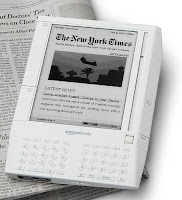
When Mack posted about his Kindle last week, one of the questions I asked him was whether it was a logject – that is, it recorded its own use with the possibility that the information gathered about his reading habits was transmitted back to Amazon. Amazon already gathers data concerning the purchases we make and if Kindles are networked logjects then they can marry that data up with what we actually do with those purchases (including our reading habits and what information we add to them, such as making notes). I’ve no idea if Kindle is a logject, and if it is what kind of logject it is, but I said I’d write a post explaining that neologism (a term that Martin Dodge and myself coined through a refinement and expansion of Bleeker’s notion of a blogject). I'm sorry if what follows is a bit academic, but it's culled from a paper we had published in Environment and Planning A earlier in the year (working paper here) but hopefully it might prove interesting because it concerns how our everyday objects are being remade to do different kinds of work in the world, including recording and communicating their use (and I'm sure they will increasingly turn up as plot devices in novels in the coming years).

The easiest way to introduce the notion of a logject is to consider the ways in which the embedding of software is changing the nature of everyday objects. Many objects now have software physically embedded into their material form. On the one hand software is used to enhance the functional capacity of what were previously ‘dumb’ objects enabling them to sense something of their environments and to perform different tasks, or the same tasks more efficiently, or to be plugged into new distributed networks that afford some value-added dimension such as data exchange on how they are used. On the other hand, software is used to underpin the design and deployment of new classes of objects, particularly mobile devices (such as PDAs, MP3 players, Satnav), that in some cases replace analogue equivalents (diaries and filofaxes, personal tape and CD stereos, paper maps and gazetteers) or undertake entirely new tasks. In some cases, software is not essential to an object’s use (such as digital clock in a cooker), but in others software has become vital to the performance of the object. The latter Martin and myself call codejects, of which there are three types differing with respect to their programmability, interactivity, capacity for remembering, their ability for anticipatory action in the future based on previous use, and their relational capacities. In summary these classes are:

Hard codejects that rely on firmware to function but are not programmable and therefore have low levels of interactivity (e.g. a USB memory stick).

Unitary codejects are programmable, exhibit some level of interactivity, although this is typically limited and highly scripted, and they do not record their work in the world. They can be subdivided into two groups:
(a) closed codejects that work independently of the world around them (e.g., alarm clock, CD player)
(b) sensory objects that sense and react to the world around them (e.g., a heating control unit using a digital thermostat).

Logjects are objects that have an ‘awareness’ of themselves and their relations with the world and which, by default, automatically record aspects of those relations in logs that are stored and re-used in the future. More specifically, a logject is (1) uniquely identifiable, (2) has awareness of its environment and is able to respond to changes in that environment that are meaningful within its functional context, (3) traces and tracks its own usage in time and/or space, (4) records that history, (5) can communicate that history across a network for analysis and use by other agents (objects and people), (6) can use the data it produces to make automated, automatic and autonomous decisions and actions in the world without human oversight, (7) is programmable and thus mutable to some degree (that is, it is possible to adjust settings, update parameters and to download new firmware). They can be subdivided into two groups based on their capacity to work independently of wider networks:

(a) permeable logjects - relatively self-contained units such as a MP3 player, a PDA, and a satnav (all of which have the potential to be connected to wider networks). Such devices trace and track their usage by default, recording this data as an embedded history; are programmable in terms of configurable settings and creating lists (e.g. play lists of songs, diary entries and route itineraries); perform operations in automated, automatic and autonomous ways; and engender socially meaningful acts such as entertaining, remember an important meeting and helping an individual to travel between locations.

(b) networked logjects - these logjects do not function without continuous access to other technologies and networks. Such logjects track, trace and record their usage locally but their full histories are also recorded externally to its immediate material form. Some networked logjects are relatively fixed in the environment (e.g. satellite/cable television control boxes, home security monitoring systems) and others are inherently mobile (e.g., mobile telephones, telematically monitored vehicles) that use a range of communication technologies such as GSM, Wifi, Bluetooth to maintain a network connection.

The other way objects are changing is that they are becoming uniquely identifiable through new tagging, so it becomes possible to know the logistics and purchase history of every item, but that's for another post.

I suspect that a Kindle is at the very least permeable logject, recording its own usage. The key question with respect to surveillance and privacy is whether it’s a network logject communicating back to Amazon details of our reading patterns and our notes? If anyone has the answer I’d be interested to know.

Wednesday, September 2, 2009

The Neutral Isle

It’s 70 years to the day that Ireland declared its neutrality in the Second World War. After Germany’s invasion of Poland on Sept 1st, the Irish Government led by Eamon de Valera declared a state of emergency and neutrality on Sept 2nd and ratified the The Emergency Powers Act on Sept 3rd. The Act, which led to the war rather euphemistically being termed The Emergency in Ireland, effectively gave the Irish government license to run the country as it saw fit for the duration of European hostilities including powers of censorship of media and mail and internment.

Neutrality was broadly welcomed by all political parties in Ireland. The country had been an independent state for less than 20 years and was still working its way through the legacy of its civil war and division from Northern Ireland. It was also a poor nation that was ill-equipped to fight any kind of war or defend itself from the kind of Blitzkrieg attack as unleashed on Poland (there were only a handful of anti-aircraft guns, a couple of obsolete planes, and a tiny professional army).

Officially favouring no side, neutrality was strictly adhered to throughout the war with British, French, German, Japanese, the United States and other states representatives based in Dublin. The government nor the press endeavoured to show any partiality to either side (the media were particularly hamstrung as they could not print or play newsreels or films that explicitly favoured one side or could be considered propaganda) and sought to repress all foreign intelligence activity regardless of source (which it actually did effectively despite the rumour-mongering of the British that Ireland was awash with German spies).

Neutrality was designed to both to stave off an attack from either side (and contingency plans were made to deal with invasion by both Britain and Germany) and to maintain harmonious relations within the Irish population many of whom were anti-British (though not necessarily pro-Nazi) after independence and the on-going debate over Northern Irish sovereignty. This neutral position clearly annoyed Churchill who repeatedly tried to bully de Valera into passing the treaty ports back into British hands and cast quite scurrilous accusations about Ireland’s role in the war, which were largely unfounded.

In practice, Ireland lent towards the Allies. Allied airmen and sailors were passed back across the border, intelligence gathered by Irish agencies was secretly shared with the British, over 50,000 Irish men served in the British armed forces (there are only a handful of documented cases of Irish men serving in German forces), hundreds of thousands of men and women worked in British factories, and German Legation activities were heavily monitored and policed. In addition, de Valera interned scores of IRA men – those most likely to be sympathetic to Germany - in the Curragh camp where 3 died on hunger strike seeking political status. The wish to remain neutral to the very end of the war though did backfire to a certain degree in the final days of the European conflict when de Valera presented condolences on the death of Hitler to the German Legation in Dublin (the only official head of state to do so). At this time it was clear the war was over and the atrocities of the death camps were well known and the gesture almost certainly did great damage to Ireland’s political reputation at the time especially with respect to the United States.

Review of The Collaborator of Bethlehem by Matt Beynon Rees, Mariner Books (2007)

Omar Yussef works as a teacher at a United Nations school in the Palestinian district of Bethlehem. With his detailed knowledge of political, religious and cultural history he tries to educate his students as to the reasons for the complex social and geographical nature of their lives and to instil a philosophy of understanding, respect and negotiation rather than hate and violence. Given the daily tit-for-tat firing of weapons across the valley between the local Martyrs Brigade and Israeli Army and regular violent deaths amongst the communities they live in, along with the vocal, hostile ideology of their parents and kin, his teachings do not always find a receptive audience. One of his success stories is his former pupil, George Saba, a Palestinian Christian. When a local Martyrs Brigade leader is killed by an Israeli sniper, Saba is accused by the Muslim martyrs of being a collaborator and is arrested by the local Palestinian police force. Both Yussef and the authorities know that Saba is innocent, but the leader’s death demands justice to be seen to be done to sate the community’s outrage, even if that means convicting and executing an innocent man. Unwilling to accept such an injustice, Omar Yussef sets out to find the real collaborator and free his friend, putting his own life at risk as he tangles with the Martyrs Brigade and the Palestinian authorities.

“When you’re a stimulating teacher, you had better be careful. You never know what you might inspire people to do.” George laughed and put his hand on Omar Yussef’s. “Don’t worry, Abu Ramiz. It’s not your fault. I thought about it for days, every time they came to the neighbourhood to shoot across the valley. Finally I knew I had to act. You see, I thought I understood the gunmen better than you, better than my dad. In South America, I saw thugs like them. They were cowards when they were confronted. Remember, I lived in Chile when the military dictatorship was forced to give up power. But unfortunately there is no-one here to back people up, no law. The criminals have made themselves the law. They shoot at some soldiers, and it transforms them into representatives of the national struggle. That makes them unassailable and they can abuse anyone they want, particularly Christians who are weak already. That was my mistake. I didn’t see that clearly enough. But I don’t regret it.”

As first novels go, they won’t come much better than this for a reader like me who likes a
mix of a strong plot, good characterization and memorable characters, informative contextual history, good pacing, a balanced blend of action and dialogue which lacks overly thick description, and a story that stimulates my interest in a place and issue and stays with me long after I finish reading it. Most of what I know about the daily lives of Palestinians is gleamed from television news. Beynon Rees opens up their world beyond suicide bombers and the conflict with the Israeli state, providing a rich, multi-textual portrait of family life, culture, politics, and institutional structures as an integral aspect of the story without it ever descending to a sermon or it rising above the story of Omar and his quest to save George. What he makes clear is that, like every society, Palestine is layered and fractured, riven with as many internal differences as exist as between it and the society it supposedly opposes. Benyon Rees’ skill is to transport you into the sights, sounds and tastes of Omar’s world, providing a rich sense of place along with a riddle of a story (although I did have a fairly good idea as to the identity of the real collaborator a long way from the end despite the efforts to keep a few potential suspects in the frame – there were enough other twists though to make this an entertaining read to the last page).

It’s a week since I finished reading The Collaborator of Bethlehem and I’ve already discussed it with half a dozen people (usually in a discussion that also involves Hans Fallada’s Alone in Berlin – my review here). The second book in the series is A Grave in Gaza and I hope to purchase it shortly to catch up with the humane and slightly chaotic life of Omar Yussef and his family.

Tuesday, September 1, 2009

The largest geopolitical project in living memory

Over the past year I've read a number of novels set either just before or during the second world war including books by Alan Furst, Philip Kerr, John Lawton, Marek Krajewski, Hans Fallada, Carlo Lucarelli and others, along with some straight history books, but I haven't been keeping track of history itself. Today marks the 70th anniversary of the start of the Second World War and Germany's invasion of Poland (The Polish Officer by Furst does a good job of capturing the first few days as Poland desperately tries to put in place the basis for resistance knowing that it is being over-run).

Of course, I haven't pre-prepared a post, but I have been thinking about doing one based on a conversation I had with Martin Dodge last week, so I'm hastily moving it forward. At his Mapping Manchester exhibition we were talking about whether the John Ryland's library had survived the blitz intact and that led onto a discussion about bomb census maps. Martin kindly sent me on a link to a story that discussed them. I'd be really interested to take a look at them in more detail. I always remember the two old ladies who lived next door when I was growing up who used to describe going up Caldy Hill to watch Liverpool and Birkenhead docks being bombed. They were great story-tellers - you felt like you were there watching the cities burn.

The tracing below is from the Christmas raids of Dec 20-22, 1940 on the Merseyside area when 365 people died. It is designed to be overlain on a base map, hence why there are so few roads, etc. shown (much cheaper to keep a clean map and have lots of tracings). A daily tracing would be taken so that the pattern of bombing could be tracked over time.


The tracing shows the area between Bootle and Walton and plots 26 separate incidents in quite a confined area. Each incident is given a number, followed by the size and type of bomb, and the location of any unexploded ordnance. Collectively the maps reveal that by the end of the war Liverpool was the second most bombed UK city after London.

These other maps are of Brighton and Bristol.


I've been fascinated by the Second World War for a while now given it was the largest and most complex geopolitical event in modern history with many civil wars operating inside transnational wars, and political ideology explicitly reshaping territory and lives through violence. I've been trying to collect books that explains what went on different parts of the world, including some that traditionally get looked over (e.g. Aleutian Islands [the only bit of the USA occupied by the Japanese], Malta, Isle of Man, Ireland, etc) so I can have a go at mentally stitching the whole lot together.

I'll perhaps try to do something on Irish neutrality tomorrow. Ireland declared its neutrality on the 2nd Sept, the day before Britain and France declared war. It was a policy that was rigidly maintained right to the end of the war.

Lest we forget ...

August Reviews

An interesting and varied month of reading. Here's a list of last month's reviews.

Black Delta Night by Jessica Speart ***
The Tin Roof Blowdown by James Lee Burke **
Fifty Grand by Adrian McKinty *****
Last Rituals by Yrsa Sigurdardottir ***
Inspector Mallon by Donal McCracken ***
Winter Frost by R.D. Wingfield ****
Stop Me by Richard Jay Parker ***
Black Out by John Lawton ****
Bombs over Dublin by Sean McMahon ***
Harold Shipman: Prescription for Murder by Brian Whittle and Jean Ritchie *****
The Last Llanelli Train by Robert Lewis ***
Death in Breslau by Marek Krajewski ***
The Shape of Water by Andrea Camilleri ****

My book of the month was Adrian McKinty's Fifty Grand. Taut and lyrical, snappy dialogue, and a smart story.
Related Posts Plugin for WordPress, Blogger...