 Next month I'm heading out to Seattle for a week, via Dallas. Whilst I'm still looking for Dallas crime fiction, I also on the hunt for crime fiction set in Seattle. I'm aware of GM Ford and I have one of his books in the TBR, but other suggestions would be gratefully received. Any ideas? One thing I've already pencilled into my diary is a visit to the Seattle Mystery Bookshop. I aim to keep a decent size space in my suitcase free for my raid on the place.
Thursday, March 10, 2011
Seattle crime fiction
Next month I'm heading out to Seattle for a week, via Dallas. Whilst I'm still looking for Dallas crime fiction, I also on the hunt for crime fiction set in Seattle. I'm aware of GM Ford and I have one of his books in the TBR, but other suggestions would be gratefully received. Any ideas? One thing I've already pencilled into my diary is a visit to the Seattle Mystery Bookshop. I aim to keep a decent size space in my suitcase free for my raid on the place.

Wednesday, March 9, 2011
Berlin at War by Roger Moorhouse (The Bodley Head, 2010)
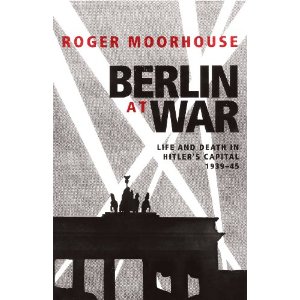 Roger Moorhouse’s premise for writing Berlin at War was that much has been written about the Nazi Party, leading figures, the German armed forces, various campaigns and theatres of war, and the Holocaust, but little has been written about the lives of ordinary Germans during the war. In Berlin at War he seeks to rectify this by using documentary evidence and war diaries to examine the lives of Berliners, and those living in the city such as diplomats, journalists and forced labourers, during the conflict. Rather than chart a straight chronological history, Moorhouse instead focuses on key themes such as rationing and sourcing food, architecture, bombings and taking shelter, entertainment, propaganda, evacuation, Jewish deportations, forced labour, regulations, governance and policing, resistance, public mood, and armed conflict. The result is a somewhat dry, but fascinating account of life in the German capital. Somewhat ironically, for a book that is meant to focus on the everyday lives of Berliners, the book starts by describing a Nazi parade for Hitler’s birthday in April 1939, rather than the mundanity of work or home life or leisure. The reliance on diaries and written testament, rather than interviews, is partially responsible I think for the quite detached tone, and it took me a little while to get into the book. By about a hundred pages in though I was hooked and Moorhouse does an admirable job of discussing a range of different issues to build up a reasonably comprehensive overview of everyday life. Not the most compelling book on the Second War World, and does not significantly extend accounts by William Shirer and Anthony Beevor or indeed the novels of Philip Kerr and Hans Falada, but an interesting read nonetheless.
Tuesday, March 8, 2011
Dallas crime fiction?
 I'm going to be in Dallas for a couple of days next month. Since I try and read crime fiction set in the places I visit, I'm looking for some recommendations for crime stories set in and around the city. Does anyone have any good suggestions? I'll also take suggestions for Texas crime fiction, but it's Dallas I'm particularly interested in.
Monday, March 7, 2011
Spitting on a Soldier’s Grave by Robert Widders (Matador, 2010)
 The subtitle of Robert Widders short book is ‘Court Martialed After Death, the Story of the Forgotten Irish and British Soldiers’. The focus is principally soldiers who deserted the Irish Army during World War II and crossed the border into Northern Ireland to join the allied services. 4,983 personnel deserted the Irish Army during the war, over 4,000 of whom joined the British services. Contrary to the belief that this was purely for financial gain, the interviews Widders conducted reveal a more complex set of reasons including boredom, political ideology, adventure, and moral justice.
If deserters returned home they could be jailed. For deserters with families, the consequence was children could be removed from the family home and placed in an industrial school through the 1941 Children’s Act that enable the state to do so if one parent was absent. At the end of the war those that served with the Allies were court martialed en masse and in absentia, with exception oddly of officers, and their names placed on a list that disbarred them from working for the state or state agencies for seven years (which was a major employer). This blanket court martial applied to those men that had fought and died fighting fascism. Not only were returning Irish soldiers disbarred from some kinds of work, they were ineligible for unemployment benefit and could not access their British demobilisation benefits, and they were publicly shunned. Those deserters that did not leave Ireland or went to Britain to work in its war factories did not face such penalties. In other words, desertion was only punished if the soldier went on to serve with the British Army, but not otherwise, clearly a highly politicised and partial decision.
Widders is clearly outraged with the discriminatory actions of the Irish state, given that those fighting the Nazis were fighting for democracy and Ireland’s future, given that Ireland would have undoubtedly been over-run and made a dominion like the rest of occupied Europe if not faced by the Allies. Whilst the book is interesting and informative, its shortcoming is depth and detail. It is relatively short at 142 pages. All of its chapters are short and partial. It reports on a number of interviews with Irish deserters who fought for the Allies, but the narrative lacks more historical context about Ireland during the war, the Irish services, Irish politics and the discourse and actions of the army and state in relation to deserters. Widders makes it clear that such historical detail is not his intention, rather wanting to get a populist book out as soon as feasible, but the argument and story does suffer as a result. Overall, a fascinating book that feels like a starter rather than the main course.

Sunday, March 6, 2011
Lazy Sunday Service
 A quiet week of blogging. A busy week at work. Yesterday at the beach in Sligo giving the dogs a salt bath. A beautiful part of the world. Should hopefully get three reviews up this coming week. Now back to reading through the first draft of Good Cop/Bad Cop.
My posts this week:
Short story: Insurance
February reviews
Scarry Nights
Wednesday, March 2, 2011
Scarry Nights
I've finally read the 59 stories in Patti Abbott's flash fiction challenge. Took me a while but I got there. All about 800-1000 words long. I tried leaving comments on a fair few, but for whatever reason, Blogger kept eating my comments. Very frustrating. These were my favourite fifteen. Not for the faint-hearted mind. The scar theme runs strong.
Kieran Shea - The Shift Change
Paul Brazill - The Endless Sleep
JF Norris - I Keep it Wherever I go
Patti Aboott - Burnt the Fire
Cameron Ashley - Robbie V Wants a Job
Brian Lindenmuth - My Brother's Keeper
Alan Griffiths - Razorblade Kisses
Jack Bates - Karaokie isn't for Wussies
Dana King - Slump Buster
Chad Eagleton - The Pit
Glenn Gray - Scars
Fleur Bradley - Restraining Order
Jimmy Callaway - Neuva Localizacion
MC Funk - Growing Scars
RL Kelstrom - Scars
Kieran Shea - The Shift Change
Paul Brazill - The Endless Sleep
JF Norris - I Keep it Wherever I go
Patti Aboott - Burnt the Fire
Cameron Ashley - Robbie V Wants a Job
Brian Lindenmuth - My Brother's Keeper
Alan Griffiths - Razorblade Kisses
Jack Bates - Karaokie isn't for Wussies
Dana King - Slump Buster
Chad Eagleton - The Pit
Glenn Gray - Scars
Fleur Bradley - Restraining Order
Jimmy Callaway - Neuva Localizacion
MC Funk - Growing Scars
RL Kelstrom - Scars
Tuesday, March 1, 2011
February reviews
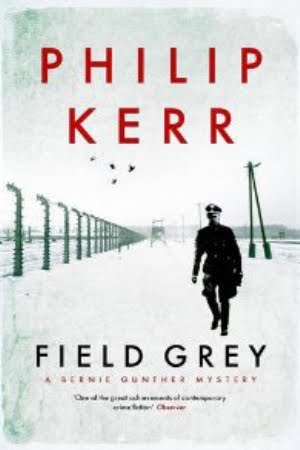 A fairly varied month of reading. The stand out book by a country mile was Philip Kerr's Field Grey. Bernie Gunther is a great character and Kerr is excellent at creating a complex plot that stretches out over twenty years, and which overlaps with the other six books. Really top-notch stuff.
Miami Blues by Charles Willeford ***
Falling Glass by Adrian McKinty ***.5
The Vienna Assignment by Olen Steinhauer ****
Dirty Old Town by Nigel Bird ****
Field Grey by Philip Kerr *****
The Ice Harvest Scott Phillips ****
The Wild Blue by Stephen Ambrose **
The Fifth Elephant by Terry Pratchett ****
Subscribe to:
Posts (Atom)
